Heartland Rising: Why Smart American Companies Are Planting Their Flags Far From the Coasts
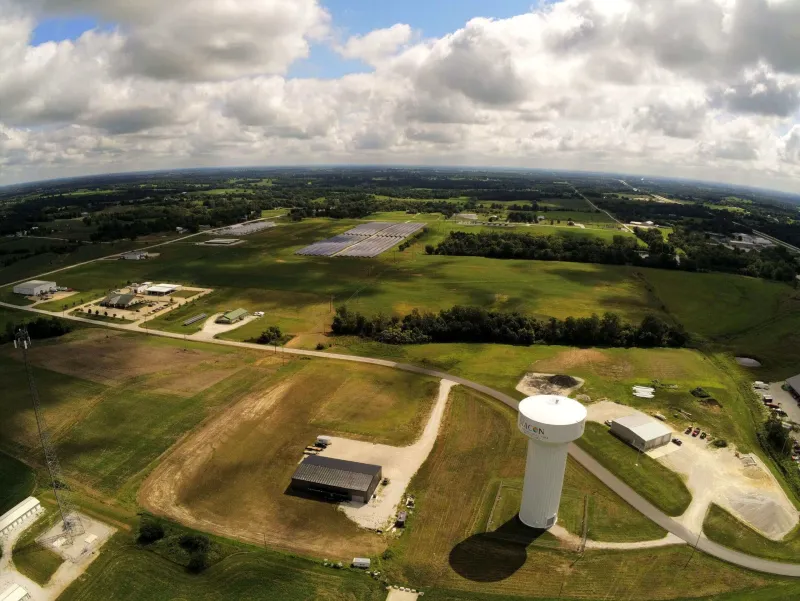
Photo: American heartland industrial facility aerial view Midwest manufacturing, via maconcounty.org
For much of the past three decades, American business geography followed a predictable gravity. Technology companies clustered in the Bay Area. Financial institutions anchored themselves in Manhattan. Biotech gravitated toward Boston. The assumption, rarely examined, was that talent, capital, and opportunity were coastal phenomena — and that companies operating elsewhere were operating at a disadvantage.
That assumption is now being systematically dismantled.
From the industrial corridors of Tennessee to the manufacturing renaissance in Michigan's smaller cities, from the logistics networks emerging in Kansas City to the advanced technology campuses taking shape in Columbus and Huntsville, a new map of American commercial vitality is being drawn. It is a map centered not on coastlines, but on capability — and it is reshaping the economics of production, talent, and operational resilience in ways that will define American competitiveness for the next generation.
The Cost Calculus Has Changed
The financial case for coastal concentration was always more complicated than its proponents acknowledged. Real estate costs in San Francisco and New York have reached levels that impose a structural tax on every business that operates there. Regulatory environments in several coastal states have grown increasingly complex and, in the assessment of many business leaders, hostile to operational efficiency. Workforce costs, driven by housing prices and cost-of-living pressures, have inflated compensation requirements to levels that strain margins across industries.
Against this backdrop, the economics of secondary and tertiary American markets have become dramatically more attractive. A manufacturer relocating from the Los Angeles Basin to a facility in Alabama or Mississippi does not simply reduce its per-square-foot real estate cost — it enters an entirely different operating environment. State-level tax incentives, often structured around job creation and capital investment commitments, can reduce effective tax burdens substantially. Utility costs, particularly for energy-intensive manufacturing and data operations, are frequently lower by meaningful margins. And land costs — the fundamental input for any facility-dependent business — are often a fraction of what comparable space would command in coastal metros.
These are not marginal differences. For a manufacturing operation or a distribution network, they represent the difference between a business model that works and one that does not.
Workforce: The Underappreciated Advantage
Cost is the entry point of the argument, but workforce is where the case becomes genuinely compelling.
Coastal labor markets are characterized by high mobility, intense competition for skilled workers, and — particularly in the technology sector — a culture of frequent job-switching that makes retention a chronic challenge. Companies invest substantially in recruiting and onboarding, only to see that investment walk out the door within eighteen months.
The workforce dynamics in America's interior and southeastern regions are measurably different. Retention rates are higher. Community ties are stronger. Workers who were raised in a region, educated there, and have family roots there are less likely to depart for a marginally better offer from a competitor across the country. For industries where institutional knowledge and operational continuity matter — advanced manufacturing, logistics, precision agriculture, healthcare services — this stability is not a soft benefit. It is a hard competitive advantage.
State and local governments across these regions have recognized this dynamic and invested accordingly. Partnerships between community colleges, technical institutes, and employers have produced workforce pipelines that are specifically calibrated to regional industry needs. In Tennessee, for example, the Tennessee College of Applied Technology network has developed curriculum in direct collaboration with automotive and advanced manufacturing employers, producing graduates who are productive from their first day on the floor. Similar models have taken root in Georgia, South Carolina, Ohio, and Indiana.
This kind of structured, employer-aligned workforce development is difficult to replicate in coastal markets, where the relationship between educational institutions and industry is frequently more diffuse.
Infrastructure Investment and the New Competitive Landscape
The federal infrastructure investments of recent years have accelerated a shift that was already underway. Highway expansions, port upgrades, broadband deployment, and rail network improvements in interior markets are reducing the logistical friction that once made coastal locations more attractive for supply chain management.
The Port of Savannah in Georgia has become one of the busiest container ports in the nation, fundamentally altering the economics of southeastern manufacturing and distribution. Inland ports and intermodal facilities in Memphis, Kansas City, and Chicago are functioning as logistics hubs that connect American producers to both domestic and international markets with increasing efficiency.
For companies managing complex supply chains — particularly those pursuing reshoring strategies in the wake of the disruptions of recent years — these infrastructure improvements make interior locations not merely acceptable but strategically superior. A facility in central Tennessee, for instance, can reach a majority of the American population within a single day's drive, a logistical reality that no coastal location can match.
Companies That Made the Move — and What They Found
The theoretical case for regional diversification is compelling. The practical evidence is becoming increasingly difficult to ignore.
Several automotive and electric vehicle manufacturers have made high-profile commitments to southeastern and Midwestern locations in recent years, drawn by a combination of workforce availability, state incentive packages, and proximity to raw material and component supply chains. These decisions were not made lightly — they reflected detailed analysis of total cost of ownership, operational risk, and long-term talent strategy.
Beyond the headline announcements, a quieter migration is occurring among mid-market companies in manufacturing, logistics, and business services. A precision parts manufacturer that relocated from coastal California to a smaller Tennessee city found that its recruiting costs declined sharply, its retention rates improved substantially, and its operating margins recovered to levels that had been unachievable on the coast. A regional distribution company that expanded its network into the Ohio River Valley discovered that it could serve a larger geographic footprint from fewer facilities, reducing both capital investment and operational complexity.
These are not isolated cases. They represent a pattern — one that is becoming visible enough to influence site selection decisions across a widening range of industries.
Building for Resilience, Not Just Efficiency
Perhaps the most important dimension of this geographic shift is the one least easily quantified: resilience.
The concentrated nature of coastal business ecosystems, while efficient under normal conditions, proved fragile when tested by supply chain disruptions, pandemic-related restrictions, and natural disaster risks. Companies that had built their operations around single-location, high-density models discovered the vulnerabilities inherent in that approach.
Geographic diversification — distributing operations across multiple regional hubs rather than concentrating them in one or two coastal metros — is a form of operational insurance. It reduces exposure to any single regulatory environment, any single labor market, and any single infrastructure system. In an era of heightened geopolitical uncertainty and domestic supply chain scrutiny, that resilience carries real economic value.
The companies that are moving to America's heartland and southeastern regions are not retreating from ambition. They are pursuing a more sophisticated understanding of what it means to build a durable American enterprise — one that is competitive not only when conditions are favorable, but when they are not. That is not a compromise. That is strategy.